Voynich Script Lab
Comprising approximately 240 surviving vellum folios written in an unknown handwriting system and adorned with bizarre botanical, cosmological, and balneological drawings, the Voynich Manuscript defies every traditional cryptanalytic paradigm.
Material Radiocarbon Baseline
In 2009, a research team led by Dr. Greg Hodgins at the University of Arizona carried out accelerated mass spectrometry (AMS) radiocarbon dating on micro-samples from four folios. The tests dated the calfskin parchment to between 1404 and 1438 CE with 95% statistical confidence.
Concurrently, McCrone Associates microscopic pigment analysis proved that the quill strokes of ink and coloring paints were contemporary with the parchment, ruling out modern 19th- or 20th-century counterfeit claims. The iron gall ink, copper carbonates (malachite), and organic plant-based binders are entirely consistent with early 15th-century Northern Italian or Alpine scriptoria.
Botanical Folios (1r - 66v)
Features 113 drawings of speculative, chimeric, or unidentified plants. Morphological studies show root systems resembling human figures, leaves grafted from multiple families, and flowers lacking recognizable angiosperm anatomy. Out of over a hundred botanical entries, only a small handful (such as Viola tricolor and Cannabis sativa) show partial botanical resemblance.
Balneological Folios (75r - 84v)
Dense clusters of miniature female figures (nymphs) bathing in interconnected pools, emerald liquid conduits, and organic piping systems resembling human circulatory or lymphatic vessels. The imagery has sparked hypotheses ranging from medieval gynecological alchemy to ritual hot-spring sanitation regimens.
Cosmological & Zodiac Charts (67r - 74v)
Circular foldouts depicting suns, stars, concentric astronomical rings, and familiar zodiac signs (Taurus, Gemini, Pisces). Uniquely, the zodiac signs are surrounded by small female figures emerging from barrels or hollow spheres holding labelled ribbons.
Statistical Paradox: The Currier Languages & Zipf's Law
In 1976, cryptographer Prescott Currier demonstrated that the Voynich text is not homogeneous. By studying letter transitions, he discovered two distinct linguistic dialects—termed "Currier A" and "Currier B"—written in differing scribe hands with sharply contrasting vocabulary distributions.
Yet on a macro statistical level, the manuscript matches natural languages with unsettling precision:
- Zipf's Law of Word Frequency: The frequency of any word is inversely proportional to its rank in the frequency table, exactly as found in Latin, English, and Arabic. Constructing a hoax that adheres to Zipf's Law without digital computers was virtually impossible in the 15th century.
- Entropy Rates: The second-order word entropy of Voynichese is markedly lower than Latin or English, exhibiting extreme word repetition (e.g., words like qokedy qokedy occurring in unbroken succession).
- Word Length Bell Curve: Word lengths follow a clean Gaussian distribution averaging 5.5 characters per word, lacking the single-letter conjunctions or prolonged compound words seen in Germanic dialects.
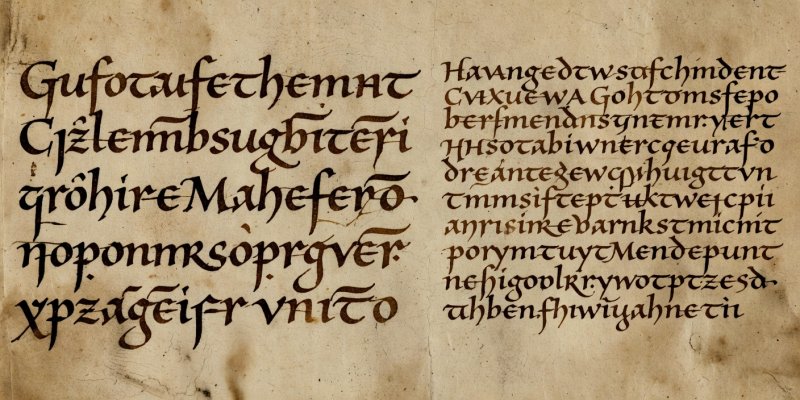
The Four Competing Hypotheses
The Curioscandi Puzzle analytical bureau monitors four active academic hypotheses regarding MS 408:
- The Polyalphabetic Cipher Model: Encoded using an early Renaissance substitution cipher with nulls and homophonic shifts, designed by an alchemist or physician to protect proprietary pharmacological compounds.
- The Constructed Shorthand Language: An early attempt at an artificial philosophical language (similar to John Wilkins' 17th-century experiments) where each consonant and vowel categorized botanical and medical properties.
- The Lost Semitic / Caucasian Dialect: Phonetic transcription of a regional spoken dialect (such as medieval Judaeo-Occitan, Old Georgian, or extinct Turkic dialects) written in an idiosyncratic cursive script.
- The Algorithmic Cardan Grille Hoax: A complex combinatorial fabrication created using moving stencils or Cardan grilles to produce authentic-looking statistical properties, intended for sale to Holy Roman Emperor Rudolf II.